
The Corruption World Cup
By Neil Tyson ACFS, Owner and Founder at Rightway Compliance
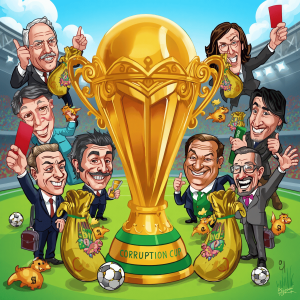 So what happens if you take every group-stage fixture at the 2026 FIFA World Cup, and map each team against the **Transparency International Corruption Perceptions Index 2025**, with each match scored on two slightly cursed metrics. What happens when you extend that take “most corrupt wins” all the way to the final. Welcome to our version of ‘The Corruption World Cup‘.
At the Group stage we have awarded two trophies: lowest combined CPI (Brazil v Haiti) and biggest perception gap (Iran v New Zealand). Useful but partial.
So we extended the exercise. Same rules, but now applied all the way through the knockout bracket. Group standings reordered by CPI ascending — most corrupt finishes top. Two-best-per-group advance. The eight most corrupt 3rd-placers join them. From the Round of 32 onwards, the more corrupt team wins every tie. Run it through R16, the quarter-finals, the semi-finals, and the final.
You end up with a tournament that produces, by structural necessity, the most corrupt final the bracket can physically generate.
It is not subtle.
The most corrupt final possible
Haiti (CPI 16) v IR Iran (CPI 23). Combined CPI in the final: 39.
The full interactive interactive scores and table are here: at The Corruption World Cup
For context: 39 is roughly the global average CPI. Two teams meeting in the championship of the men’s game with a combined integrity perception that, averaged out, equals the world’s mean. That is not how finals usually work.
Haiti wins.
The podium is filled out by Congo DR (20) in third, beating Iraq (28) in the play-off. The four medalists are the four lowest-CPI teams in the entire tournament — and they get there because the bracket structure happens to keep them in separate halves until the semi-finals. Nothing in this is engineered. It just falls out of the geometry.
Three Group E fixtures are unscored, because the CPI doesn’t separately rate Curaçao — they’re folded into the Kingdom of the Netherlands, and using the Netherlands score (78) as a proxy is documented to substantially overstate Curaçao’s actual integrity profile. So Group E has three rankable teams (Ecuador 33, Côte d’Ivoire 43, Germany 77) and one unscored. Ecuador and Côte d’Ivoire advance; Germany gets pushed into the 3rd-place contingent pool and is cut. Curaçao is ineligible by data, not by football.
For purists who want a Group of Death analogue: Group C is the only group whose top two seeds are both inside the tournament’s bottom four for CPI. Haiti and Brazil between them carry a combined CPI of 51 — the lowest of any pair of top-two-seeded teams in any group.
The caveats that always matter
CPI measures perception, not crime. It captures expert and business-leader views of public-sector corruption. It says nothing about a national football team, its squad, its coaches, or any player. Haiti’s footballers are not corrupt. Iran’s footballers are not corrupt. Their state apparatuses are perceived by external experts as more so than most. The distinction matters, and the headline above is structural — not a claim about anyone on the pitch.
CPI also doesn’t see the enablers — the financial centres, the corporate vehicles, the discreet professional services — which is why top-scoring nations like the Netherlands and the UK sit at the centre of cross-border corruption networks the index does not penalise. If you take only one thing from this piece: a CPI score above 70 is the floor, not the ceiling.
Data: Corruption Perceptions Index 2025, Transparency International, published 10 February 2026 (CC BY-ND 4.0). Bracket structure: 2026 FIFA World Cup tournament regulations, Annex C, row 230.
Whether you’re seeking to strengthen your compliance framework or need bespoke training for your team, we can help. Please get in touch.
About the Author: Neil Tyson ACFS, is Owner & Principal Consultant at Rightway Compliance, with over 30 years of experience in fraud investigation, AML compliance, and player protection across regulated sectors including gambling, financial services, and public sector organisations. He previously led national investigation strategy at the Legal Services Commission and held senior roles at FTSE 100 companies including Centrica plc.
FURTHER READING
-
Transparency International Red Card for Corruption
- Transparency International CPI Index 2025
To receive articles such as this direct to your inbox you can sign-up for our regular newsletter
Check out our new toolkit – pre-register for free today for 50% off and special bonus material
We have also produced a number of additional resources you may find useful which can be downloaded for free. We will be releasing new resources over the next few weeks – sign up to be the first to hear
ECCTA – Board Actions for Developing an anti-fraud culture
ECCTA – One page explainer for a sceptical board
ECCTA – Fraud Typologies Analysis